
Why Your Meetings Feel Polite But Powerless
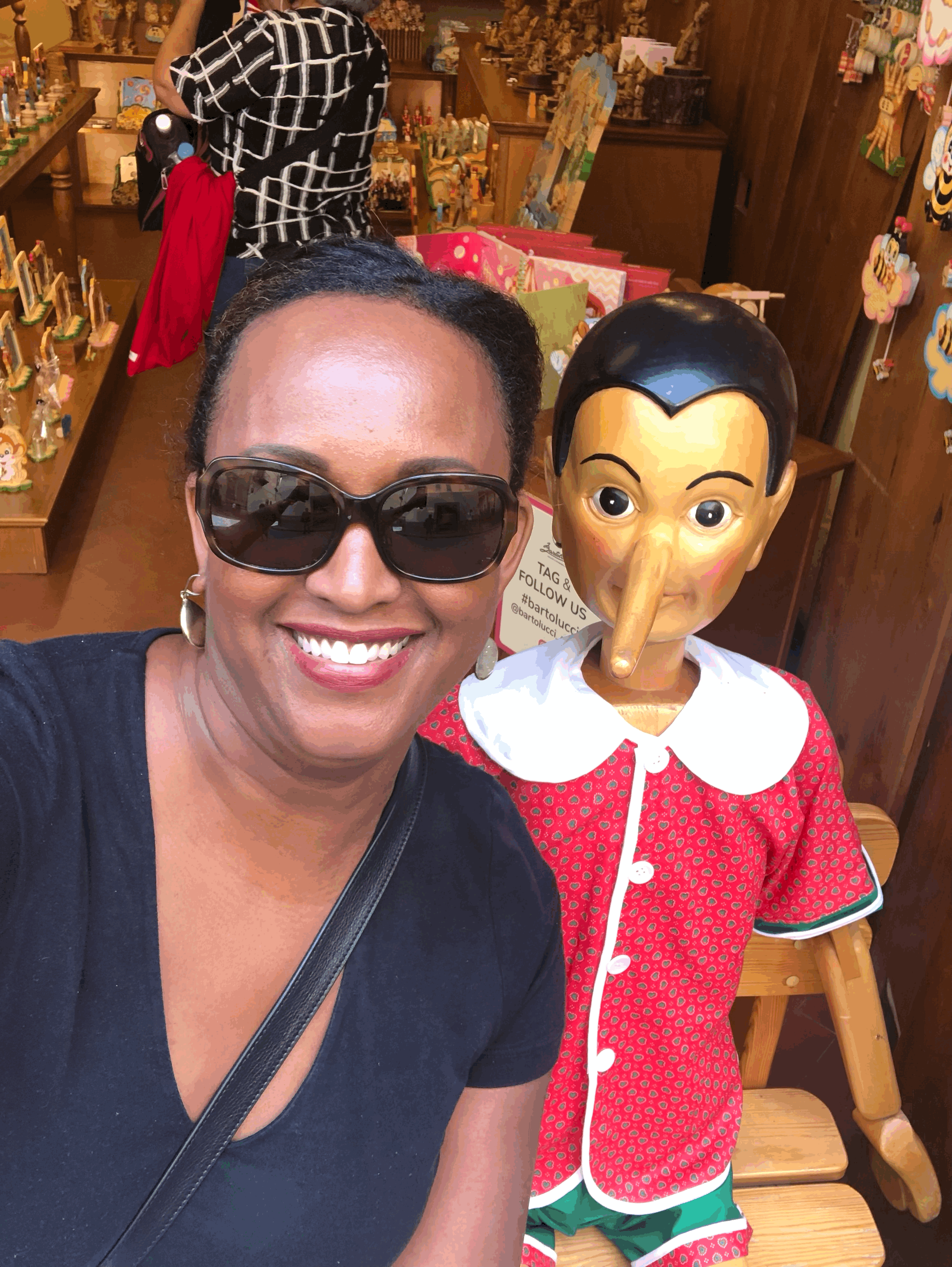
A few years ago, I was in Florence, Italy for a women’s leadership mastermind when I stumbled upon a life-sized wooden Pinocchio. Naturally, I took a photo (because how could you not?), but the image stuck with me for more than its charm.
Because here’s the thing:
When leaders don’t speak their truth — or don’t feel safe to — everyone notices.
The nose grows.
The room tightens.
And strategy, culture, and momentum stall.
Most leadership teams aren’t held back by dishonesty.
They’re held back by a lack of psychological safety.
It’s not that people are lying. It’s that they’re holding back.
They nod in meetings, even if they disagree. They leave with action items, but not with energy. They feel something is off — but they stay quiet because speaking up feels risky.
And let’s name the risk:
Being labeled difficult or disloyal
Offending a leader who “means well”
Saying something you can’t unsay(!!)
Or becoming that person who’s always the devil’s advocate
So we sanitize. We self-edit. We keep the peace.
Yet here’s the cost:
When the truth stays tucked under the table, your team can’t lead (nor do they want to follow)…
Not effectively. Not boldly. Not together.
As a certified StratOp facilitator, one of the most powerful things I get to do is create space for the truth to emerge—without shame, blame, or spin.
In these sessions, all voices are heard.
Hard things are named without personal attack.
And disagreement isn’t a sign of disloyalty—it’s a sign of maturity.
Because when candor is normalized and safety is modeled:
✨ Clarity rushes in.
✨ Strategy becomes real.
✨ Teams stop pretending—and start performing.
So if your meetings (…and your culture, and your results…) have been feeling polite but powerless, here are three leadership truths to sit with:
Surface-level conversations lead to surface-level results.
Strategy, culture, and decisions suffer when real concerns stay unspoken.Psychological safety isn’t a vibe — it’s a skill.
It can be taught. It must be modeled. And it starts with leadership.You don’t need a culture of conflict — you need a culture of candor.
This isn’t about being combative. It’s about being courageous enough to lead with your truth.
When’s the last time your team had a real truth-telling moment?
If you can’t remember—or if you're noticing that too many “yeses” feel like polite avoidance —it might be time for something different.
Whether through executive coaching or guided strategy facilitation, I can help your team build the trust to tell the truth — and the skills to lead with it.
In the absence of psychological safety, your leadership can’t grow.
And your Pinocchio moment? It’s already in the room. The question is whether you’re ready to name it.
Are your meetings creating alignment, or simply preserving the appearance of it?
When the real conversation happens after the meeting, the organization pays for every truth that stayed outside the room.
Let’s explore what it would take to build more candor, trust, and productive tension into the way your team works.
Cassandra Shepard is the founder of Shepherd + CO, a boutique strategic advisory firm. She works with senior leaders navigating the intersection of enterprise strategy and advanced leadership. www.cassandrashepard.com